Funabashi
Funabashi, a fairly large town facing a muddy bay in Chiba Prefecture, serves as the crucial geographical frame for the epilogue of No Longer Human. It is here, in a coffee shop run by the Madam of the Kyobashi bar, that the unnamed narrator—a university acquaintance now teaching at a women's college—first encounters the material evidence of Yozo's life: three notebooks and three photographs. The town thus becomes the site where the fragmented, first-person confession of the preceding notebooks is handed over to an external reader, transforming a private chronicle of shame into a published document and making Funabashi the literal and symbolic threshold between Yozo's sealed-off past and the public act of witness.
Setting and Atmosphere
Funabashi is introduced in the epilogue as a destination the narrator visits in February, during the cold season, to buy fresh seafood for his family and to ask a friend to help arrange a relative's marriage. The town is described as facing a muddy bay, and the narrator's search for his friend's house proves difficult; nobody seems able to give him directions by street and number. The physical discomfort of the cold and the weight of his rucksack drive him into a coffee shop, attracted by the sound of a violin record playing inside. This unremarkable, slightly weary atmosphere—a small coastal town in winter, a shop with music, a stranger seeking directions—provides the ordinary setting against which the extraordinary material of Yozo's notebooks will be introduced. The madam, whom the narrator had last seen ten years earlier at her bar in Kyobashi, now runs this coffee shop in Funabashi, and the two express exaggerated surprise and laugh a great deal upon recognizing each other.
The Transfer of the Notebooks
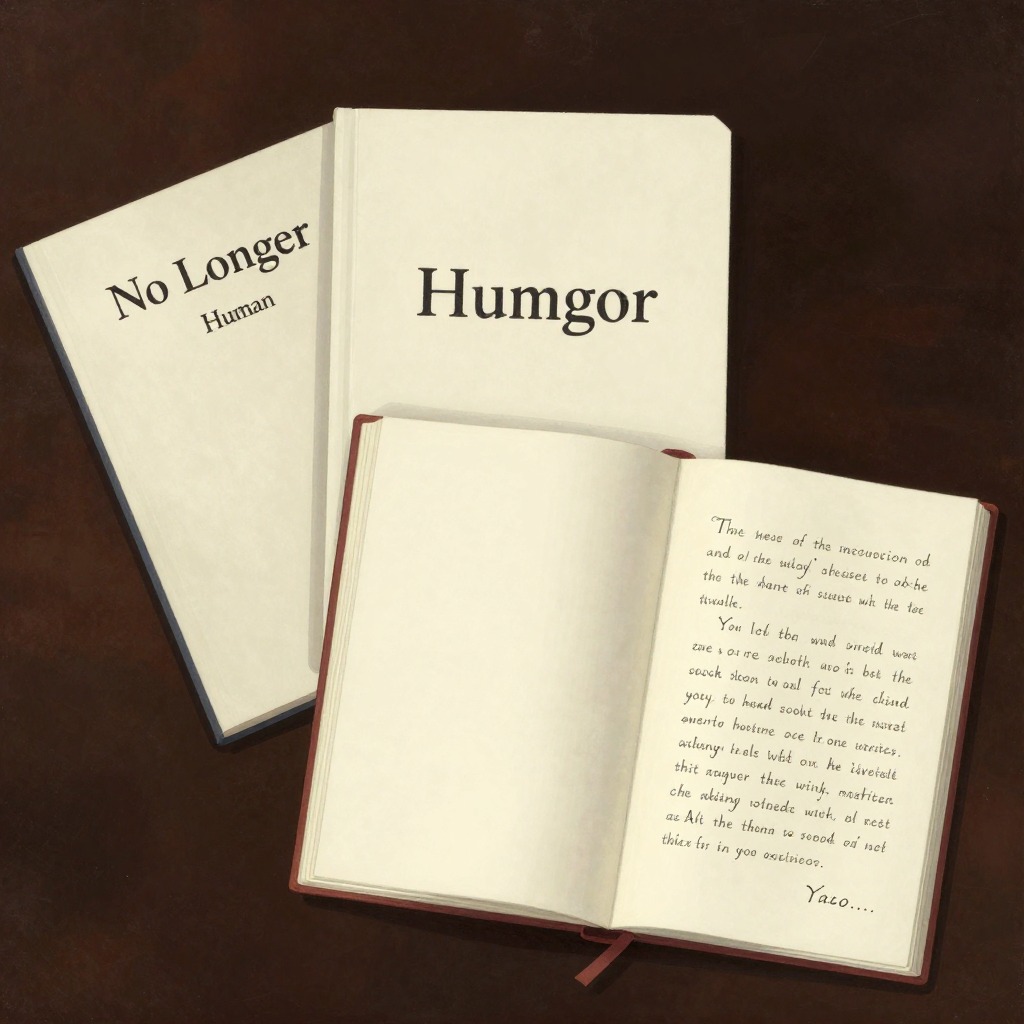
The central event of the Funabashi episode is the madam's decision to hand over Yozo's three notebooks and three photographs to the narrator. She does so unprompted, asking if by chance he had ever known Yozo, and when he answers that he never had, she retrieves the materials from inside the shop and offers them with the words, "Maybe they'll make good material for a novel." The narrator initially intends to return them without even examining them, but the photographs fascinate him, and he decides to accept the notebooks. He promises to stop by again on the way back, and asks the madam if she knows where his friend lives; as a fellow newcomer to Funabashi, she does, and directs him to a house just a few steps away. That night, after drinking with his friend, the narrator becomes so immersed in reading the notebooks that he does not sleep a wink until morning. The following day, he returns to the coffee shop and asks to borrow the notebooks for a while. The madam agrees, and when he asks whether the man who wrote them is still alive, she replies that she has no idea—about ten years earlier, someone sent her a parcel containing the notebooks and photographs to her place in Kyobashi, without an address or name, and she is sure it was Yozo who sent it. The notebooks survived the air raids, and she read through them for the first time only recently.
Narrative Significance
Funabashi is not merely a geographical location but the narrative hinge on which the entire structure of No Longer Human turns. It is the place where the first-person, confessional voice of Yozo is received, read, and ultimately transmitted to a wider audience by a second party. The madam's final, unemotional judgment—"The Yozo we knew was so easy-going and amusing, and if only he hadn't drunk—no, even though he did drink—he was a good boy, an angel"—is delivered in this coffee shop in Funabashi, providing the only external testimony that contradicts Yozo's own devastating self-portrait. The town thus becomes the site of the novel's final act of witnessing, where the reader, like the narrator, is left to reconcile the "angel" described by the madam with the "reject" who wrote the notebooks. Funabashi, a modest coastal town facing a muddy bay, is transformed into the quiet stage for the novel's most profound reversal: the discovery that Yozo's life, however wretched, was seen by at least one other person as something worthy of love.